
More information can be found in this blog.
| 1-5 Connections | $40 |
| 6-10 Connections | $12 each |
| 11+ Connections | $20 each |
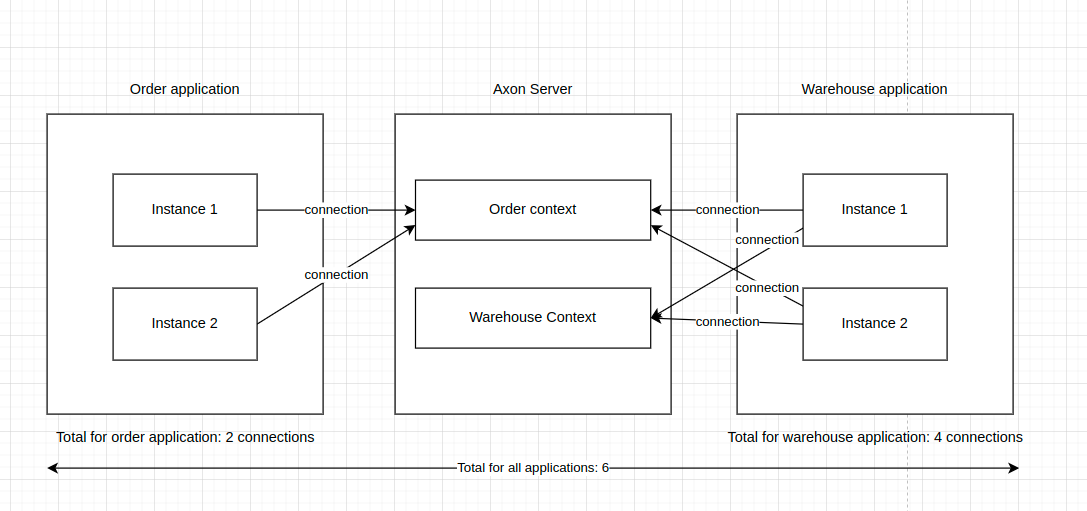
A connection refers to a single active link between an application instance and Axon Server. Each application requires at least one connection, the one for its default context. Without configuring additional contexts in your application, only one connection per application instance will be used. However, an application opens an additional connection for each configured context besides the default one, and each of these connections are counted separately.
When you run multiple instances of the same application, each instance will open its own connection. Therefore, two instances of an application that use two connections will count as four connected applications, total.
In the example below, the order application connects only to its default context, “order,” and thus uses one connection. The Warehouse application, however, listens to the events from the “order” context to process orders. Furthermore, it has its own context to store events. Therefore, it uses two connections per application instance.

Empowering businesses with innovative solutions to help them thrive in the digital world.
© 2025 AxonIQ. All rights reserved. Cookie Settings
